


Home > Ruud History > Water Heater History
Ruud History

Ruud water heaters trace back to Norwegian-American inventor Edwin Ruud, who created the first practical automatic gas water heater in the late 1880s and built a company that later became a flagship brand of Rheem Manufacturing.
The name still appears on tank, tankless, hybrid heat-pump, and commercial water heaters—as well as furnaces and air conditioners—more than 135 years after the first units went into production.
The story is one of immigrant engineering, early patents that made on-demand hot water ordinary, factory expansion in Pittsburgh and Kalamazoo, acquisition by a California drum-and-tank maker, and later Japanese ownership that kept the brand alive as a contractor-focused line.

Ruud early 1900s vadvertisement, changing the refrence from Instantaneous to Automatic

Edwin Ruud left only a handful of photographs. The best-known is a 1922 trade-journal portrait

RUUD No. 3 – Type E, Serial No. 155560
Patent dates shown are from 1907 and 1908
The founder: from Askim to Pittsburgh
Edwin Ruud (born Edvin Ruud) was born June 9, 1854, on a farm in Askim, Østfold, Norway. He trained as a mechanical engineer at Horten Technical School in Vestfold. After working in Swedish and Norwegian shops, he immigrated to the United States in 1880. He held jobs in Philadelphia, with the Pennsylvania Railroad in Altoona, and at Reading Iron Works before arriving in Pittsburgh in 1887.
There he joined George Westinghouse’s Fuel Gas and Manufacturing Company, which was developing gas appliances and controls. Ruud filed his first U.S. patent in 1882 (a balanced slide valve) and later assigned several inventions to the Westinghouse firm. He married the singer Minna Kaufmann (1872–1953); the couple had no children. He remained connected to Norway throughout his life.
Ruud's first invention
US Patent 260,612 is Edwin Ruud’s first U.S. patent: a “Balanced Slide-Valve” for steam engines, filed November 12, 1881, and granted July 4, 1882.
It is not a modern Ruud furnace, air conditioner, or water-heater model number. It is the inventor’s earliest American patent, issued while he was a young Norwegian immigrant working as a draftsman at the Pennsylvania Railroad’s Altoona shops.
Patent details
-
Title: Balanced Slide-Valve
-
Inventor: Edwin Ruud (citizen of Norway), Altoona, Blair County, Pennsylvania
-
Filed: November 12, 1881
-
Issued: July 4, 1882
-
Assignee: None
-
Status: Expired (term would have ended around 1899)
-
Google Patents: patents.google.com/patent/US260612A
-
Original PDF: patentimages.storage.googleapis.com/.../US260612.pdf
What the invention does
A conventional slide valve in a steam engine sits on its back under full boiler pressure. That pressure creates heavy friction against the port face, wasting power and wearing the valve.
Ruud’s design adds a regulating cylinder of two different diameters. Steam is admitted to the steam chest only until the pressure is just high enough to keep the slide valve seated—not the full boiler pressure. Area proportions between the large and small ends of the cylinder are matched to the area of the slide valve versus the steam ports. An adjustable spring-and-screw and a steam gauge let the operator set that pressure.
The five claims cover the combination of the slide valve with that stepped regulating cylinder, the passages and grooves that feed and vent pressure, and the spring/screw adjustment.
Invention of the automatic water heater
Before Ruud, households typically heated water in kettles or on stoves, or used crude, non-automatic boilers. In 1889, while still at Fuel Gas and Manufacturing, he designed an automatic storage-tank gas water heater: a tank heated from below by a gas burner whose valve was controlled by water temperature. He patented the design in 1890 (U.S. Patent 443,797, issued December 30, 1890) and later that year expanded it (U.S. Patent 460,513, September 29, 1891). Production of the early storage design began around 1889.
On January 22, 1897, he filed a separate patent for an improved “Automatic Water Heater.” Issued September 6, 1898, as U.S. Patent 610,281, it used a cast-iron shell enclosing the burners and a copper-tubing coil through which water flowed, plus thermostat-controlled gas valves. The stated object was “to maintain the supply of water at the desired temperature at all times.” This coiled-tube instantaneous (tankless-style) heater became the product that made the Ruud name famous. He left Westinghouse, acquired rights to his own work, and founded Ruud Manufacturing Company in Pittsburgh in 1897, with plumber and heating engineer James Hay as an early partner.
The Type F instantaneous heater (available in standard- and low-pressure versions, burning natural gas, LP, or gasoline) could deliver 3, 4, 6, or 8 gallons per minute. By 1915, roughly 100,000 units had been installed in the United States and Canada. Catalogs emphasized a simple promise: turn the faucet, and hot water appears; close it, and the gas goes out.
Key patents associated with Ruud and the early company
Ruud and the company obtained numerous U.S. and foreign patents covering valves, thermostats, burners, storage tanks, and instantaneous heaters. Notable examples include:
-
U.S. 260,612 — Balanced slide-valve (July 4, 1882)
-
U.S. 443,797 — Water heater (December 30, 1890)
-
U.S. 460,513 — Water heater/temperature control (September 29, 1891)
-
U.S. 610,281 — Automatic water-heater, coiled-tube design (September 6, 1898)
-
U.S. 682,345 — Automatic cut-off for gas-service pipes (September 10, 1901)
-
U.S. 853,738 — Storage water-heater (May 14, 1907)
-
U.S. 875,217 — Thermostatic-valve-operating mechanism (December 31, 1907)
-
U.S. 1,257,932 — Water valve for instantaneous water heaters (February 26, 1918)
Later company patents (assigned to Ruud Manufacturing) continued into the 1920s and 1930s, covering refined heaters and related apparatus. The firm also defended its intellectual property in court, including a 1912 infringement suit against Pittsburgh Water Heater Co. over burner patents.
Awards and honors during Ruud’s lifetime
The automatic heater earned international notice:
-
1904 — Gold Medal, Louisiana Purchase Exposition (St. Louis World’s Fair) for the automatic water heater.
-
1905 — Edward Longstreth Medal of Merit from the Franklin Institute for the Ruud Instantaneous Automatic Water Heater.
-
1927 — Honorary Doctor of Science, University of Pittsburgh.
-
1927–1929 — Knight, then Commander, of the Royal Norwegian Order of St. Olav.
In 1926, Ruud and his wife established a substantial fund (about 1 million kroner) to support vocal education for Norwegian and Swedish women. His will left a large bequest to his home region; the money later funded the construction of Edwin Ruud's Hospital, a geriatric care facility in Eidsberg, Norway, which opened in 1964.
Company growth: Pittsburgh, Kalamazoo, and beyond
Ruud Manufacturing expanded by acquisition. In 1908, it absorbed the James Hay Company (heating and plumbing engineers) and Folsom-Webster Co.; Hay became company president, and Folsom headed the Cincinnati branch. By 1915, the firm had offices in Pittsburgh, Kalamazoo, Toronto, and Hamburg.
The most important manufacturing move came on March 24, 1913, when Ruud purchased the Humphrey Company of Kalamazoo, Michigan, a major water-heater maker with a large plant. Humphrey’s Herbert S. Humphrey stayed on as vice president; he himself held dozens of heater and valve patents. Ruud kept and enlarged the Kalamazoo works. In 1937, the Humphrey Division moved to a bigger factory on Factory Street. In 1954, the company shifted all remaining Pittsburgh operations to Kalamazoo, which served as headquarters until the sale to Rheem.
After Edwin Ruud’s death on December 9, 1932, in Pittsburgh (age 78), the company continued under professional management. His widow died in 1953. In the 1950s, Ruud added heating and air-conditioning equipment, extending the brand beyond water heating.
Acquisition by Rheem and later ownership
Rheem Manufacturing, founded in 1925 by brothers Richard and Donald Rheem as a galvanizing and steel-drum business in California, entered the water-heating business after acquiring tank and boiler manufacturing capacity. It became a large U.S. water-heater producer and introduced glass-lined tanks (1954) and the “Rheemaire” central air-conditioning line (1956).
In 1959–1960, Rheem purchased Ruud’s water-heater business (sources vary slightly on the exact year; Rheem’s own centennial materials use both). The Ruud corporation was later dissolved (1964), but the brand continued as a Rheem division. Rheem used Ruud’s Kalamazoo plant and distribution network and kept the name for water heaters and, later, HVAC products sold primarily through independent contractors.
In 1988, Paloma Co., Ltd., of Nagoya, Japan—one of the world’s largest gas-appliance makers—acquired Rheem (after a brief period under Pace Industries). Rheem remains a privately held U.S. subsidiary. Headquarters are in Atlanta, Georgia.
Chris Peel is president and CEO. The broader group, organized as Paloma Rheem Holdings, has since added GENERAL (formerly Fujitsu General, 2025) and a majority stake in France’s Groupe Atlantic (completed May 2026), creating a larger global air-and-water company. Ruud continues as one of the family’s established North American brands.
Product evolution and modern lineup
The original instantaneous coil heater and early storage tanks gave way to glass-lined steel tanks, power-vent and power-direct-vent models, low-NOx burners, and high-efficiency condensing designs. In 2009, Rheem and Ruud introduced one of the first hybrid heat-pump water heaters sold in North America—more than twice as efficient as conventional electric tanks.
Today, Ruud’s water-heating range includes:
-
Conventional atmospheric, power-vent, and high-efficiency gas and electric storage tanks (Achiever, Achiever Plus, Professional Ultra series).
-
Condensing tankless units (SR-Series and related lines) with recirculation pumps that can cut wasted water by thousands of gallons per year.
-
Hybrid electric heat-pump water heaters (Ultra series), with UEF ratings as high as about 4.07, and features such as LeakGuard/LeakSense, Wi-Fi (EcoNet), and flexible installation.
-
Commercial Triton and other heavy-duty gas heaters with leak detection and monitoring.
-
Super-high-efficiency gas tanks using helical-coil heat exchangers and built-in condensate neutralization
The same brand covers residential and light-commercial HVAC: Endeavor-line furnaces (including modulating high-AFUE models), heat pumps (some with low-GWP refrigerant), packaged units (Renaissance, Resolute), and indoor-air-quality accessories. Many products qualify for ENERGY STAR, federal 25C tax credits, and builder 45L credits.
Brand awards and reputation
Founder-era medals are listed above. In the modern era, the Ruud (and Rheem) lines have received:
-
Consumer Reports recognition for reliability in water heating.
-
ComfortTech Innovation Awards for HVAC products, including the Super Quiet 80 furnace and the Modulating 90-Plus furnace.
-
ENERGY STAR Partner of the Year honors (multiple years for the parent company).
-
CES Innovation Award (Rheem ProTerra plug-in heat-pump water heater, 2023, Sustainability category).
-
Internal Rheem “Edwin Ruud Innovator of the Year” awards that explicitly honor the founder’s name.
-
Various sustainability and “Eco-Leader” recognitions for high-efficiency heat-pump and condensing products
Ruud is typically positioned as a professional/contractor brand—durable, widely serviced, and complementary to (rather than identical with) the Rheem retail line. Independent reviews often describe it as a solid mid-to-premium choice with strong warranties (commonly 8–12 years on tanks and parts, longer on some heat exchangers).
Timeline at a glance
Year Event
1854 Edwin Ruud was born in Askim, Norway
1880 Immigrated to the United States
1887 Joins Westinghouse Fuel Gas and Manufacturing, Pittsburgh
1889–90 Designed and patented the first automatic storage-tank gas water heater
1897 Founds Ruud Manufacturing Company; files coiled-tube automatic heater patent
1898 U.S. Patent 610,281 issued
1904 Gold Medal, St. Louis World’s Fair
1905 Franklin Institute Longstreth Medal
1908 Acquires Hay and Folsom-Webster firms
1913 Absorbs Humphrey Company, Kalamazoo
1915 ~100,000 instantaneous heaters installed; international offices
1927–29 Honorary doctorate (Pitt); Order of St. Olav
1932 Edwin Ruud dies in Pittsburgh
1950s Ruud HVAC line introduced
1954 Operations consolidated in Kalamazoo
1959–60 Rheem acquires Ruud water-heater business
1988 Paloma (Japan) acquires Rheem
2009 Hybrid heat-pump water heater introduced under Rheem/Ruud
2020s Ultra hybrid, SR-Series tankless, Endeavor HVAC; Paloma Rheem expands in Europe
The Ruud name has outlived its founder by nearly a century because the original insight—automatic, reliable hot water without constant attention—remained commercially valuable as technology moved from cast-iron coils to glass-lined tanks, condensing exchangers, and heat pumps.
The brand today is no longer an independent Pittsburgh manufacturer; it is a long-running product family inside a global air-and-water group. The continuity of the name, the contractor channel, and the emphasis on durability still echo Edwin Ruud’s 1890s claim that the heater would “maintain the supply of water at the desired temperature at all times.”
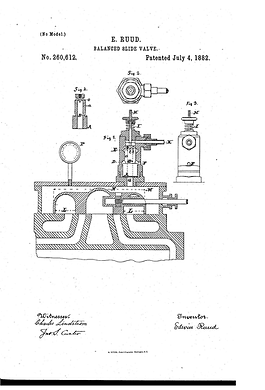
1882 Ruud US 260,612, Balanced Side Valve

1904 - Ruud Gold Metal, St. Louis World's Fair

1891 Ruud Patent No. 460,513, First Water Heater

1907 Ruud Patent No. 853,738, Storage water heater