


Chronology
>
c. 5000 bce
Stone boiling
>
c. 2500 bce
Great Bath
>
c. 1000 bce
Ondol
>
c. 80 bce
Hypocaust
>
1st c. ce
Testudo

The tank in your closet is a young object with an old mind
Yours is sold as a nineteenth-century appliance — Maughan’s geyser, 1868; Ruud’s tank, 1889. That is when it became a product.
Not when you needed a bath. A vessel. A fire. Somewhere for the warmth to linger. This page follows the physics from a river stone to the Great Bath, the Roman testudo, the ofuro, and the cylinder behind your wall.
01 — Prehistory
The first boiler was a stone
c. 5000 BCE River valleys worldwide
Long before anyone owned a tank, people owned fire, water, and rocks. Across the late Stone Age, a method now called stone boiling appears wherever pottery was scarce, and hunger was not. Stones were heated until they glowed, then eased with sticks into a pit lined with hide, bark, or clay. The water jumped. Fat rendered. Roots softened. Tea, in a sense, had begun.
It is an inelegant machine and a perfect one. A stone is a thermal battery. Water is a patient solvent. Together they store heat the way a modern cylinder does, only the cylinder is a hole in the ground and the burner is a river cobble.
Archaeologists find fire-cracked rock in middens from the American West to the Eurasian steppe: the slag of the original water heater.
Pottery changed the geometry but not the physics. Once a vessel could sit on a fire, the pit became a pot. The question that would occupy engineers for the next seven millennia was already on the table: how do you heat water without standing over it, and how do you keep it hot after the fire dies?

Heated river stones lowered into a hide-lined pit of water at dusk, steam rising beside a fire.

The Great Bath is the earliest monumental public water tank yet found. Whether the water was warmed remains unproven.
02 — The First Public Water
A tank in the citadel
c. 2500 BCE Mohenjo-daro, Indus Valley
The Great Bath of Mohenjo-daro, a monumental brick tank with descending stairs in late sunlight.
On the high mound of Mohenjo-daro sits a rectangle of brick that is still, after four thousand years, the earliest known public water tank. The Great Bath measures roughly twelve meters by seven, and a little more than two meters deep. Staircases drop from the north and south. A bitumen lining made the masonry watertight. A corbelled drain carried the used water away.
We do not know if the water was heated. Honesty matters here: no furnace has been proved beneath the tank, and the filling system itself is still argued over. What the bath proves is older and quieter. A city had already decided that water, gathered, held, and shared, was civic architecture. Purification, not plumbing, may have been the point. The engineering is still plumbing.
If the water heater has a public ancestor, it is this: a vessel large enough for a people, not a pot. Everything later — the Roman alveus, the hammam basin, the Japanese ofuro, the porcelain tub — is a variation on a tank that someone bothered to make leakproof.
The Great Bath is the earliest monumental public water tank yet found. Whether the water was warmed remains unproven.
03 — metal learns fire
Copper, bronze, and the dedicated vessel
3000 – 500 BCE·Egypt, China, the Aegean
Copper changed the hearth. It conducts heat as clay never could, and it can be raised, lidded, poured, and repaired. In Egyptian houses and temple kitchens, wide basins sat on brick furnaces; water for washing, brewing beer, and ritual was brought to a boil and carried off in jugs. The heater and the bath were still two rooms apart. The idea of a pipe between them had not yet arrived.
In Shang and Zhou China, the bronze ding — a tripod cauldron of ritual gravity — was a boiler in ceremonial dress. Water and meat, wine and grain, were heated over an open fire in vessels whose surface was itself an argument about power. The same workshops that cast those bodies understood, empirically, what a later engineer would call specific heat.
On the Greek mainland, public baths — balaneia — were running by the fifth century BCE. Athletes scraped oil from their skin and rinsed it from hydria that had sat on braziers. A round sweating-room, the laconicum, borrowed Spartan severity. By 350 BCE, the Temple of Artemis at Ephesus may already have been using a form of underfloor heating. The Mediterranean was teaching itself that heat could be a building, not only a pot.

Egyptian courtyard at dusk with copper cauldrons steaming over a brick hearth.

A ding is a ritual vessel and a boiler. The same bronze that argued for kingship also argued with fire.

At Greek balaneia the heater still lived in the yard: a cauldron, a brazier, and a walk to the basin.

A traditional Korean hanok room warmed by ondol, winter light through paper doors, a kitchen fire at the side.
04 — warm stone
The ondol never left the house
c. 1000 BCE – present·Korean Peninsula
On the Korean peninsula, a different answer took root and never quite left. The ondol — gudeul, “baked stone” — is underfloor heating that treats the house itself as a stove. A kitchen fire, the agungi, sends smoke and heat through flues under thick stone slabs. The floor stores the day. You take your shoes off because the floor is the radiator.
Possible traces reach into the Bronze Age; by the Goguryeo kingdom, the L-shaped ondol is archaeologically secure. Chinese observers recorded it. It heated palaces and farmhouses alike. Unlike the Roman hypocaust, which served baths and villas and then vanished with the empire that paid for its fuel, the ondol remained ordinary. It still names the way most Korean apartments are warmed — only now the flues carry water instead of smoke.
That last substitution is the whole history in one gesture. A culture that learned to heat stone with fire eventually heated the same stone with hot water. The water heater did not replace the ondol. It moved inside it.
Modern Korean ondol typically circulates water through pipes in the floor — a direct descendant of a smoke-flue idea more than two millennia old.
05 — the first water heater
Hypocaust, testudo, three bronze tanks
2nd c. BCE – 5th c. CE·Rome and the provinces
Rome did not invent hot water. It industrialized it. Beneath the floors of baths and northern villas, a furnace — the praefurnium — drove hot gases through a forest of brick piers called pilae. The suspended floor above became a vast radiating plate. Hollow box-tiles, tubuli, carried the same breath up the walls. Vitruvius, writing in the first century BCE, already treated the system as architecture, not novelty. Tradition credits Sergius Orata, around 80 BCE, with hanging baths — balneae pensiles — though the idea was older than his oysters.
The water itself was heated in boilers set over those same furnaces: lead or bronze vessels large enough to feed an alveus, the hot pool of the caldarium. A bronze half-cylinder called the testudo alvei — the tortoise of the tub — sat half in the fire and half in the pool. As bathers displaced water, cooler liquid slid into the tortoise, boiled, and returned by convection. It is a tankless heater with a Latin name.
Vitruvius describes three connected boilers, for hot, tepid, and cold, arranged so that drawing from one replenishes it from the next. The Baths of Diocletian held a reservoir of some twenty thousand cubic meters. The Baths of Caracalla burned through forests. What looks, in the ruin, like a forest of stumps is the skeleton of the first central heating plant — and of the first building that could promise hot water on a civic timetable.
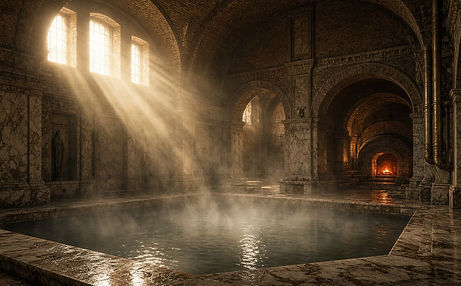
Interior of a Roman caldarium: vaulted hall, steaming pool, shafts of light, a furnace glowing beyond an arch.
How it worked
Anatomy of a
Roman water heater
The hypocaust is remembered as underfloor heating. It was also a plant for making water hot: a furnace, raised floor, wall flues, and a bronze boiler sharing one fire.
the furnace
Praefurnium
A wood- or charcoal-fired furnace at the edge of the building. Its job is not to heat a room directly but to throw a river of hot gas under it.
In great thermae the stokeholes ran day and night.


under the floor
What looks, in the ruin, like a forest of stumps is the skeleton of the first central heating plant.
The same fire that warmed the pavement warmed the water. Rome did not separate the two problems. That is why the hypocaust belongs in a history of water heaters, not only of floors.
06 — the line that did not break
Hammam steam, ofuro fire
6th – 18th c. The Islamic world and Japan
When the Western Empire failed, the hypocaust mostly failed with it. Fuel was expensive. The labor that fed furnaces was a political fact, not a household appliance. In much of medieval Europe, hot water returned to the pot on the hearth, and bathing became occasional, medicinal, or suspect.
The idea survived where bathing remained a public good. Byzantine baths kept the furnaces lit. Islamic hammams inherited the hypocaust almost intact: a wood-fired hypocaust under marble, a hot room, a warm room, a fountain of cold water, and copper bowls. The göbektaşı — the navel stone at the center of the hot chamber — is a Roman floor that learned a new language. From Córdoba to Damascus to Ottoman Istanbul, the water heater remained a building.
Japan took the opposite scale and made it intimate. Natural onsen did the heating where the ground was already boiling. Where it was not, the ofuro — a deep wooden tub, later a cast-iron goemonburo with a firebox beneath — brought the furnace back under the water. You wash before you enter. The water is for soaking, not scrubbing, and it is kept.
A household water heater, in other words, with a philosophy attached.

Ottoman hammam interior with a heated marble platform, steam, and star-shaped light from the dome.

Victorian bathroom with a tall copper gas geyser water heater mounted above a clawfoot tub.
07 — the appliance
A geyser in the bathroom, a tank in the closet
1868 – 1889·London and Philadelphia
The modern object arrives late, and slightly on fire. In 1868, Benjamin Waddy Maughan, an English decorative painter, patented a gas-fired instantaneous heater he called the Geyser. Cold water ran through a copper cylinder while Bunsen burners licked its flanks. There was often no flu. The bath was hot. The room was a risk. It is the ancestor of every tankless unit now humming on a wall.
Safety, storage, and a thermostat still had to be invented as a single machine. In 1889, Edwin Ruud, a Norwegian mechanical engineer working in Philadelphia, built the first automatic storage-tank gas water heater. A tank held a reserve. A valve watched the temperature. Gas utility service, just then spreading through American cities, gave it a fuel. Ruud patented the design in the 1890s and founded a company that still bears his name. The Saturday-night bath could become a Tuesday morning.
Look at Ruud’s cylinder, and you can still see the Great Bath, the ding, the testudo. A vessel, a fire, a way to keep the heat from leaving. The ancient problem was never how to make water hot. It was how to make it hot without thinking about it. That is the part that is new.
four constants
Every later machine is a rearrangement of these.
Vessel
A pit, a pot, a brick tank, a bronze tortoise, a copper geyser, a glass-lined cylinder. The container changes. The job does not.
Fire
Stone, dung, wood, charcoal, gas, resistance wire, a heat pump. Every water heater is a negotiation with fuel.
Patience
Stone boiling is storage. Ondol is storage. Ruud’s tank is a storage. Tankless heaters refuse storage and buy it back with flame.
The floor
Korea and Rome both discovered that the best radiator is the thing you already stand on. Modern hydronic floors are their grandchildren.

coda
Turn the tap.
The water that arrives without ceremony has seven thousand years behind it. You do not have to know any of this to get clean. It is nicer if you do.
A short history of the hot water you already use. Dates move. The physics does not.
