
Historial de calentadores de agua


Home | What's Inside The Tank | Water Heater History
“What’s inside the tank, and why is it there?”
Every part on your heater exists because something used to go wrong.
Glass lining
Glass lining is the reason a water heater became a mass appliance instead of a custom copper vessel. It is also the reason that appliance eventually leaks. The short version most sites use — “A.O. Smith patented it in 1936” — is directionally true and sloppy in the way your site exists to fix.
A.O. Smith learned to glass-line brewery tanks, patented the process in 1936, and put it into residential tanks in 1939. That is why cheap steel replaced copper and Monel after the war — and why tanks now have a finite life instead of lasting for decades.
It is not a pane of glass
“Glass lining” is porcelain enamel, also called vitreous enamel. Mineral frit — silica and other oxides melted, quenched, and ground — is sprayed or slushed onto steel, then fired at roughly 1,500–1,650 F, so the coating fuses to the metal. The result is a thin ceramic skin. It is not a liner dropped in. It is not window glass. It is a fired glaze bonded to the tank wall.
Two properties of that glaze explain everything that follows:
-
It isolates cheap steel from water, so a tank does not have to be copper, Monel, or Everdur.
-
It is thin, brittle compared with the steel under it, and never perfect. Pinholes, weld holidays, and thermal-cycle cracks are built into the design. That is why the sacrificial anode exists.

Otto E. Uecker, US patent 2,263,021, filed June 24, 1938
What tanks were before the glaze
Hot-water storage already existed. The problem was the vessel.
Galvanized steel was the cheap option. Zinc bought some time. Once the zinc was gone, or once a weld left bare iron, electrolytic corrosion ran. Uecker’s later patent is blunt about the inspection problem: galvanize after you assemble the tank and you cannot see the defects.
Copper, copper-lined steel, Monel (copper-nickel), and Everdur (silicon bronze) resisted corrosion without an anode. They also cost too much for a postwar house. Some of those tanks are still in service. That is the comparison glass lining has to beat: not “did it rust eventually,” but “could a factory sell a tank to a family that would not have bought copper.”
Glass-on-steel won because it made a commodity tank good enough. It did not make an immortal tank.
Earlier enamel work that is not tank lining
A.O. Smith was already patenting vitreous enamel before the brewery tanks:
-
US 1,842,298 — Lloyd Raymond Smith — Underground pipe line — filed February 11, 1929, issued January 19, 1932. Vitreous enamel baked onto the outside of oil/gas pipe for soil corrosion. Not an interior lining.
-
US 2,267,361 — Orrin E. Andrus — Corrosion-resistant metallic structure — filed April 6, 1935, issued December 23, 1941. Vitreous enamel plus cathodic protection, written for pipelines. A.O. Smith later sued on this patent as the foundation of glass + anode protection. It is not a tank-lining method.
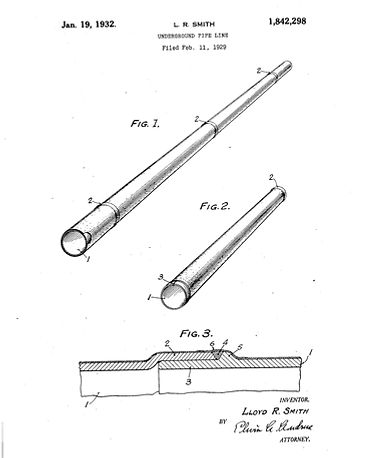
UNITED STATES PATENT OFFICE LLOYIj RAYMOND SMITH, OF MILWAUKEE, WISCONSIN, ASSIGNDR TO A. 0. SMITH CORPORATION, OF MILWAUKEE, WISCONSIN, A CORPORATION OF NEW YORK UNDERGROUND PIPE LINE Application filed February 11, 1929. Serial No. 339,1455.
US 1,842,298 — Lloyd Raymond Smith
Beer paid for the chemistry
A.O. Smith was a Milwaukee steel and welding company — baby-carriage parts, then bicycle tubing, then auto frames for Ford and others, then large-diameter pipe. In 1930 it built a dedicated research building and staffed hundreds of engineers. One problem they studied was fusing glass to steel.
Repeal of Prohibition in 1933 gave that work a customer. Brewers needed large, clean vessels that would not flavor the beer. In 1933 the company introduced the first large single-piece glass-lined brewery tank. Over the next 32 years it built more than 11,000 of them. The same chemistry later produced glass-lined beer kegs and, after the war, Harvestore farm silos. Water heaters were a spin-off of a beer-tank process, not the other way around.
Company interviews in 2024 still tell the Depression story this way: leadership told the engineers to drop non-core glass work and concentrate on surviving products. The engineers kept going on their own time because they thought they were close. Attribute that as company oral history. It is a good story. It is not a patent file.
The “1936 patent” problem
Corporate timelines all say A.O. Smith patented the glass-lined water heater in 1936. Treat that as the company’s date for the invention, not as a single document you can cite by number until you have the file in hand.
What the public patent record actually shows is a cluster:
Year What happened
1933 First large single-piece glass-lined brewery tank
1935 Andrus corrosion-protection filings that become US patent 2,267,361 (issued Dec. 23, 1941): glass fused to steel plus cathodic protection.
1936 Company date for applying the process to water heaters
1938–39 First water-heater-specific patents
1939 Residential production begins (Permaglas)
1940–43 Uecker’s construction patents for a lined tank you can actually manufacture
WWII Civilian production stops; barracks heaters continue.
1946–47 Kankakee plant; volume through Sears Kenmore and others
1955 Core patent window closes; competitors glass their own tanks
The water-heater patents that survive in plain view are construction patents, not a magic “we invented glass” patent:
Orrin E. Andrus, US patent 2,179,476, filed Aug. 31, 1938, issued Nov. 14, 1939. “Hot water tank and connection.” How to put fittings into a vitreous-enamel tank without turning the opening into a corrosion cell.
Otto E. Uecker, US patent 2,263,021, filed June 24, 1938, issued Nov. 18, 1941. “Domestic hot water tank.” Three-piece shell-and-heads construction so each piece can be enameled and inspected before welding. Prior lined tanks failed because you could not see the holidays until the tank was already closed.
Otto E. Uecker, US patent 2,322,488, filed May 6, 1940, issued June 22, 1943. “Glass lined hot water tank.” The visual patent. Vitreous enamel frit is applied to the shell, fused, coats as needed; heads and flue are enameled separately; parts are assembled after enameling; welds sit out at overlapping edges so welding heat does not wreck the lining inside the water space. Smooth transitions, no sharp corners. That last point is not styling. Sharp corners crack enamel.
Uecker describes the shop process in the 1943 patent: form the steel shell, flare the ends, attach fittings that must go on before firing, apply frit, fuse it, inspect, then weld. Firing temperature in the related domestic-tank patent is given as about 1,600 F
That is the real invention for a website like yours: not “they coated a tank in glass,” but “they figured out how to enamel a welded pressure vessel at the seams and fittings.”

Orrin E. Andrus, US patent 2,179,476, filed Aug. 31, 1938

Otto E. Uecker, US patent 2,322,488, filed May 6, 1940
How a factory actually lined a tank
The sequence has not changed in principle since the late 1930s.
-
Form the steel shell and heads. Early A.O. Smith practice used flash-welded cylinders and flared ends so heads could be pressed in.
-
Prepare and attach any fittings that have to be on the part before firing.
-
Clean the steel — blasting or chemical etch — so the enamel will wet the surface. Cobalt oxide in the ground coat is the classic adhesion trick for enamel on steel.
-
Apply frit as slurry, slush, spray, or later electrostatic powder. Multiple coats are normal.
-
Fire until the frit melts and bonds. Modern water-heater enamel is still typically fired in the mid- 1,500s to low-1,6001 °F.
-
Inspect. Re-spray and refire defects if you can still reach them.
-
Assemble. Either weld after lining (Uecker’s method) or line a nearly finished vessel and accept harder inspection at the seams.
Later manufacturing patents — Wayne A. Deringer’s US 2,959,850 in 1960, for example — are still arguing about the same problem: how to weld a head onto a pre-lined shell without leaving a bare circumferential seam inside the water.

Wayne A. Deringer’s US 2,959,850 in 1960
1939, the war, then the American tank
A.O. Smith began mass-producing residential glass-lined heaters in 1939 under the Permaglas name. World War II stopped civilian production. The same plants made bomb casings, landing gear, propeller blades, jeep frames, and water heaters for barracks. After the war the housing boom needed a cheap, uniform tank. Glass-lined steel was that tank.
Encyclopedia.com dates the expiration of A.O. Smith’s glass-lined water-heater patent to 1955. After that the company eased out of some private-label residential work and leaned toward commercial equipment. That date is why the mid-1950s suddenly fill up with competing trade names.
-
Bradford White Vitraglas: first use claimed 1951; trademark activity 1953.
-
Rheem Rheemglas: mid-1950s. Rheem could then stop depending on copper tanks.
-
State porcelainized tanks: late 1950s.
-
A.O. Smith Burkay B-65: first glass-lined commercial heater, 1953 or 1954 depending on which company timeline you read. Flag the one-year disagreement.
By the 1960s, “a water heater” in an American basement usually meant a glass-lined steel tank with an anode rod. Copper and Monel did not disappear overnight, but they left the middle of the market.
The same glass-to-steel process also left the farm landscape: Harvestore silos from 1949 are glass-fused-to-steel cousins of the water heater. People who grew up seeing blue Harvestores already know the material. They just don’t connect it to the tank in the garage.
The anode is the second half of the invention
Early glass-lined tanks were sold as if the glaze did all the work. It never did.
A 1952 paper by W. A. Deringer and E. W. Nelson in Corrosion is the document that makes this honest. A.O. Smith research “more than twenty years” earlier had shown that cathodic protection works better on glass-fused-to-steel than on bare metal, because the glass is non-conductive and does not drain the anode. That work produced patent 2,267,361. In the field, though, the lining was still the sole protector — and linings have holidays. They ran a 12-city test: four glass-lined and two galvanized heaters in each city, coatings deliberately damaged, magnesium anodes installed as a “pinch hitter” for exposed steel.
Andrus had already patented anode protection at tank openings in 1944 (US 2,343,440), because fittings are where the glaze is most likely to be incomplete.
So the mass-market formula is not “glass lining.” It is:
thin vitreous enamel + sacrificial anode + accept that the steel will eventually be eaten at the holidays.
When the anode is gone, the lining’s pinholes become the leak. Hard water, high temperature, and chlorides speed both the anode’s death and the attack on any exposed steel. In Phoenix-class water an anode can be spent in a few years. That is not a modern decline from a golden age. That is the design.
Later foam insulation made the problem worse in a quiet way: it buried the anode opening so nobody pulled the rod. The chemistry did not change. Access did.
Why the lining itself fails
Four failure modes matter for a history page that homeowners will actually use.
Holidays. No production lining covers 100% of the steel. Welds, fittings, and drain openings are the usual misses.
Thermal cycling. A gas burner under a tank, or an electric element inside it, expands the steel. Cold inlet water contracts it. Glass does not stretch with the steel. Crazing and spalling start at stress points — the bottom head on a gas tank, the element openings on an electric tank.
Water chemistry. Soft, aggressive water and hard, mineral-heavy water attack the system differently, but both can win. Scale hides damage and overheats the bottom. Soft water can keep the anode working overtime.
Steel gauge. Once glass lining made cheap steel acceptable, the commercial temptation was thinner steel and a longer-sounding warranty. The lining and anode then have less metal behind them when they fail.
That is the honest answer to “why did Grandpa’s tank last 25 years and mine lasted 8.” Sometimes Grandpa had copper or heavier steel. Sometimes he had softer water and replaced an anode. Sometimes the story is nostalgia.
What changed after the basic recipe
The 1938–43 construction idea is still the industry. The glaze formulas are not frozen.
-
Permaglas / Permaglas Ultra Coat — A.O. Smith’s house name for the lining, later a slush-coat process aimed at more uniform coverage on commercial tanks.
-
Cyclone commercial heaters (1990s) — still glass-lined steel, with a different heat exchanger and coating method.
-
Blue Diamond (A.O. Smith / State, 2004) — a later formula the company claimed had more than twice the corrosion resistance of standard lining. Treat the multiplier as a manufacturer claim. The historical point is that “glass lining” has been reformulated for 80 years.
-
Powered anodes — an attempt to stop depending on a rod that disappears. The lining is still there; the backup changed.
Cement-lined commercial tanks (Hubbell and others) are the parallel tradition: a thicker, different barrier, used where glass holidays and anode maintenance are unacceptable. They belong in a sidebar so readers don’t think glass was the only lining science.
Sacrificial anode
The rod dies so the tank does not. In hard water — Phoenix, Scottsdale, much of the Southwest — it can be gone in a few years. That is the real reason “10-year tanks” often fail at 6–8. History plus local water chemistry is content almost nobody else can write with your shop experience.
T&P valve
Superheated water flashing to steam can throw a tank through a roof. Watts filmed Explosion Danger Lurks in the early 1940s to force the industry to take relief valves seriously. The little brass valve on every tank is the result of real explosions, not a code footnote.
Dip tube
The mid-1990s polypropylene dip-tube failures left plastic crumbs in faucets nationwide. A short, sourced page on that episode explains a part most people have never heard of.
FVIR chamber
After garage gasoline vapors ignited at standing pilots, flammable-vapor ignition resistance became the residential gas-tank standard on July 1, 2003. That is why the bottom of a modern gas tank looks different from a 1990s tank.