
Historial de calentadores de agua


Home > Dating Water Heaters > Water Heater History
Dating Water Heaters


Below you will find the actual formulas on how to read a rating plate and decode a serial number by manufacturer family — and what that date actually proves.
ON THIS PAGE
-
What you are dating
-
Where to look
-
How to use this page
-
Bradford White
-
Rheem / Ruud / Richmond
-
A. O. Smith / State / American
-
GSW / John Wood
-
Tankless families
-
Other and older units
-
When two dates are possible
-
Sources and limits
What you are dating
A water heater’s serial number is a factory tracking code. On most North American tanks and many tankless units, part of that code is the date of manufacture — the week or month the unit left the plant. That is not the same as the day it was installed, sold, or first fired.
A household kettle never needed a date code. A mass-produced tank does. The code exists because the industry had to warrant glass-lined steel vessels, track plants, and identify production lots. Dating a heater is therefore a small act of industrial archaeology: you are reading a factory’s filing system off the side of a tank.
The rating plate can prove when the unit was built. It cannot prove remaining life, water quality, anode condition, or whether the tank has already leaked. Treat the date as evidence of origin, not a sentence.
Where to look
Use the factory rating plate — the metal or foil label on the jacket. On a conventional tank it is usually on the upper third of the side facing the room. On a gas tank it often sits just above the gas control. On a tankless unit it is on the side or bottom of the cabinet.
Copy three lines together: brand as printed, model number, and serial number. Do not use the yellow EnergyGuide sticker or a plumber’s service tag. Those are later additions. Some modern plates also print a plain “MFG. DATE.” If that line is present and legible, it overrides a decoded guess.
How to use this page
North American water heaters are best dated by manufacturer family, not by the badge alone. Rheem builds Ruud and Richmond. A. O. Smith builds State, American, Reliance, and a long list of store brands. Bradford White is its own letter system. A Kenmore or Whirlpool tank is almost never a Kenmore or Whirlpool factory.
Find the family first. Then match the serial to the format used in that era. Formats change when plants change computer systems, when one company buys another, and when a line moves from month-year to week-year.
Bradford White
Two-letter date code
Also seen as Jetglas on older tanks. Some Bradford White Infiniti tankless units are Rinnai-built and do not use this code — see Tankless families.
The first two characters of the serial are the date. The first letter is the year; the second is the month. The rest is a consecutive production number: seven digits before December 2007 (serial prefix DM), eight digits after. Bradford White’s own chart is the authority for this family.
Year letters skip I, O, Q, R, U, and V, which is why the alphabet repeats every twenty years. Month letters run A through M and skip I.


Worked example
JC16433183 — J is the year, C is March. An eight-digit production tail points to the post-December 2007 series, so March 2012 rather than March 1992.
Known exception
A small run of serials beginning OA was built in January 1997 after a computer error. Bradford White documents this on the official chart.
Rheem / Ruud / Richmond
Month-year, then plant-week-year
Same coding family: Rheem, Ruud, Richmond, and many tanks badged GE, Hotpoint, Professional, Vanguard, Western Auto, and other channel names. Rheem acquired Ruud around 1959–1960; the Ruud name survived as a wholesale brand. Marathon / Eclipse units from Water Heater Innovations use related but not identical labels.
Read the plate first. Many Rheem-family labels print a manufacture date in plain month and year. If they do, stop there.
Older 10-digit form (widely used until 2012)
Rheem Technical Service Bulletin 1207 describes a ten-character serial:
BLOCK MEANING
First two digits Month (01–12)
Next two digits Two-digit year
Letter Plant / line code
Last five digits Consecutive serial

Example. 0912D01234 — September 2012, plant line D, unit 01234.
2012-onward plant form
Starting 2 April 2012 at Mexicali and 4 June 2012 at Nuevo Laredo — then plant by plant —
Rheem moved to a week-and-year serial:
P + WW + YY + sequence, sometimes with a conversion suffix letter and sometimes
behind a product prefix such as RHLN or RHNG.
PLANT LETTER PLANT
A Montgomery
C Canada
M Mexicali
Q Nuevo Laredo
W Water Heater Innovations (Marathon / Eclipse)
Examples. M141209135 — Mexicali, week 14 of 2012. Q231299996 — Nuevo Laredo, week 23 of 2012.
Because plants changed over on different days, a digits-first MMYY serial can still appear after April 2012. Do not force a week reading onto a month-year label, or the reverse. If the first two digits after any prefix are 13–52, you are looking at a week, not a month.
A. O. Smith / State / American
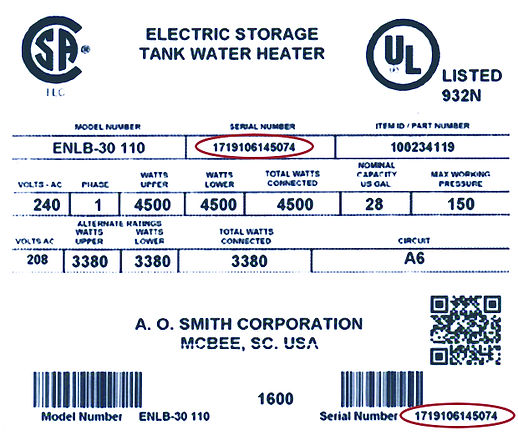
Year-week on the modern group; letter-month on older lines
A. O. Smith, State, American, Reliance, Glascote, Perma-Glas, U.S. Craftmaster, ProLine, and a long list of hardware and store brands built in the same plants. A. O. Smith acquired State Industries in 2001 (agreement announced September 2001; closing 28 December 2001) and American Water Heater Company in the same era. Serial formats were still settling through the late 2000s.
Current group form (common from about 2008)
An 11-character style is typical: first two digits = year, next two = week of that year, then a plant letter and a production sequence.
Examples. 1210A002243 — week 10 of 2012. 1839A123456 — week 39 of 2018. A leading plant letter may sit in front of the same four date digits.
Older A. O. Smith form
Before the group standardized, A. O. Smith / Glascote / Perma-Glas often used a letter for the month in the second position and two digits for the year in the third and fourth. Month letters run A–N excluding I (A = January … N = December).
Example. *H06******* — August 2006.
Older State / American form
State Industries commonly used a first-letter month and a two-digit year immediately after it (J89… = October 1989).
American and U.S. Craftmaster tanks often used the first four digits as year then week (8906… = week 6 of 1989).
After the plants were combined, try the modern year-week reading if the older one produces nonsense.
GSW / John Wood
Year then month, first four digits
John Wood, GSW, Moffat, Superflue, Medal, and related Canadian labels. GSW later entered the A. O. Smith orbit; confirm the printed brand and do not assume a U.S. State/American code without checking.
A common historic form puts year in the first two digits and month in the next two: 8901… = January 1989. Later units may follow the A. O. Smith year-week pattern. Prefer a printed manufacture date when the plate has one.
Tankless families


Rinnai Tankless
Units from about 2009 often open with two letters: first letter = year starting at A = 2009, second letter = month A–M skipping I. Pre-2009 units more often use digits, year then month (0703… = March 2007). Bradford White Infiniti and some other badges are Rinnai-built; decode those as Rinnai, not as Bradford White tanks. Letter-year tables after the mid-2010s are not perfectly settled in secondary sources — confirm against the printed date on the cabinet label.
Navien Tankless
The date usually sits after a five-character factory prefix, not at the front. Next come two digits of the year, one character of the month, and two digits of the day. Months 10–12 are written X, Y, Z.
Example. 7414C14X1771143 — after prefix 7414C, read 14 / X / 17 = 17 October 2014. Older Navien serials use a hyphenated calendar block, such as 9262-20081208-1027 (8 December 2008).
Noritz Tankless
Often the most literal of the group: a four-digit year and two-digit month, sometimes separated by a period. 2018.06 is June 2018.
Other and older units
Giant (Canada) often prints the date on the tank label rather than hiding it in the serial.
Lochinvar commercial and residential lines have used more than one plant code. Do not apply a Bradford White or Rheem table to a Lochinvar serial by habit.
Vaughn / SEPCO and other long-lived specialty makers (stone-lined, commercial, point-of-use) frequently put a date on the nameplate. When they do not, manufacturer literature beats a generic chart.
Heat-pump and hybrid units from the major tank makers generally follow that maker’s current serial family. The heat pump is a refrigeration loop bolted to a tank; the date code is still a tank-plant code.
Nineteenth- and early twentieth-century heaters — Maughan Geysers, early Ruud automatics, Kemp Climax solar tanks — are dated from patents, catalogs, and construction, not from modern serial logic. Those objects belong on the timeline and in the gallery, not in a decoder table.
When two dates are possible
Every two-digit year and every twenty-year letter cycle produces twins. Resolve them with the rest of the object:
-
Sequence length (Bradford White’s 7-digit vs 8-digit tail after December 2007).
-
Model series and features that did not exist in the earlier cycle (foam insulation thickness, FVIR combustion, electronic gas valves, UEF labels after 2017).
-
ANSI / CSA standard year printed on the plate — usually a few years older than the tank, never newer.
-
Physical condition is only a last resort, and never as the only argument.
If two readings remain plausible, record both and say so. A history site can live with an unresolved date. A warranty claim cannot.
Sources and limits
This page follows manufacturer charts and service bulletins where they are public: Bradford White’s serial-number date-code reference (including the OA / January 1997 note and the seven-to-eight-digit change at DM / December 2007);
Rheem / Ruud bulletin 1207 and the April–June 2012 plant-label change; A. O. Smith’s 17 September 2001 announcement and 28 December 2001 closing of the State Industries acquisition. Secondary decoder charts (InterNACHI and inspector tables) are useful for store-brand lists and older examples, but they flatten era changes and should not override a maker’s own key.
Codes drift. Plants migrate. A store brand can move from one family to another. When a serial refuses the table, photograph the whole plate — model, serial, standard year, and any printed date — and treat the photograph as the primary source.
This is a living reference. It will be corrected as manufacturer keys and documented plates accumulate.
Waterheaterhistory.com • Dating Water Heaters • Manufacture date is not install date.